Small changes in the classroom can make a difference in students’ ability to learn, connect, and succeed. UC Merced's Wellness in the Classroom Toolkit was adapted from Simon Fraser University's Well-being in Learning Environments. Start with these five tips, then explore the rest of the toolkit by category below:
1. Check in with your students.
Use a quick check-in at the beginning of class to create connection and get a sense of how students are doing. This can be as simple as asking students to share 1–2 words about how they are feeling through a chat, poll, or word cloud.
2. Connect students to support.
Make campus resources visible and easy to find. Include relevant resources in your syllabus, Canvas course, slides, or class discussions so students know where to turn when they need support. Refer to our shared folder for Health & Wellness Resources for ideas and ready-to-go tools.
3. Build in brief breaks.
Give students an opportunity to pause, stretch, or take a breather during longer classes. Short breaks can help students reset and return their attention to learning.
4. Make expectations clear.
Provide clear instructions, explain available resources, and use rubrics or examples when appropriate.
5. Seek feedback.
Use a quick poll or survey to ask students what is working and where they may need additional support.
Try these first:
- Build in brief breaks. Give students an opportunity to pause, stretch, or go outside during longer classes. Short breaks can help students reset and return their attention to learning (Deskercise).
- Share a bit about yourself. Talk about your career path, or setbacks you’ve overcome.
- Set a caring tone. Acknowledge that university can be intimidating and stressful and let students know you care about their success.
- Check in with your students. Use a quick check-in at the beginning of class to create connection and get a sense of how students are doing. This can be as simple as asking students to share 1–2 words about how they are feeling through a poll or word cloud.
More ideas:
- Introduce yourself during your first class and learn a little bit about your students’ needs.
- Share your teaching philosophy with students (Developing a Teaching Philosophy).
- Take care of your own well-being so that you can be present and encouraging for students (UCM Employee Wellness).
- Provide an inspiring or funny quote within your slides to lighten the mood.
- Allow students space to be wrong and encourage alternate viewpoints.
- Create a friendlier syllabus that promotes student equity, belonging, and growth using tips from the Student Experience Project learning module.
Try these first:
- Build in reflection. Use brief journaling or other reflective activities to encourage personal growth.
- Connect coursework to real life. Help students identify how the skills they are developing—such as teamwork, communication, problem solving, empathy, and initiative—apply beyond the classroom.
More ideas:
- Offer mindfulness or other skill-building activities during class breaks or as part of the course.
- Encourage students to connect with campus departments or student organizations that offer connection/learning opportunities, including Campus Advocacy, Resources & Education (CARE), Health Promotion, the Office of Social Justices and Initiatives, and the Office of Student Involvement.
- Encourage students to seek co-curricular, volunteer, experiential learning, and internship opportunities (Community Engagement Center, and UCM Natural Reserve System).
- Invite the Leadership Center to facilitate one of their College 101 workshops.
- Encourage students to seek career exploration through the Career Center.
- Encourage students to seek financial literacy training through the Financial Wellness Center.
Try these first:
- Seek feedback. Use a quick poll or survey to ask students what is working and where they may need additional support.
- Be easy to contact. Provide multiple ways for students to contact you with questions or concerns.
- Make course materials accessible. Consider providing lecture notes or slides ahead of class and lecture recordings when appropriate.
More ideas:
- Offer students the option to choose their “best two out of three” for assignments, quizzes, or exams.
- Offer students choices in assignments.
- Use interactive tools like Zoom polls, Poll Everywhere, or Kahoot to promote class engagement.
- Consider using free or low-cost educational resources.
- Allow exam retakes when appropriate for your discipline.
Try these first:
- Create opportunities for students to connect. Design lecture assignments that require students to collectively work on study questions and participate in small group discussions.
- Encourage study connections. Invite students to form study groups (or assign them).
More ideas:
- Use a social connectedness start-up activity on the first day of class (Icebreakers).
- Include group process in grading rubrics to emphasize the importance of effective teamwork.
- Encourage students to exchange contact information with at least one peer.
- Suggest opportunities for students to interact outside of class (if you have time to join them that is even better).
- Invite a Career Coach to speak on building networking strategies.
- Offer mini breaks in class and encourage students to take this time to get to know one another.
- If possible, move tables and chairs into small groups to facilitate discussion.
Try these first:
- Provide multiple ways to participate. Offer options to accommodate different learning styles such as discussion, written reflections, small-group activities, or oral presentations.
- Make expectations clear. Provide clear instructions, explain available resources, and use rubrics or examples when appropriate.
- Encourage students to speak to you about accessibility concerns. Student Accessibility Services can provide consultation and resources if needed. Make it clear that you genuinely care about working with students on accommodations.
- Use inclusive language. Use language that respects historical and cultural context and gender neutral pronouns.
More ideas:
- Create class guidelines together that establish expectations for respectful discussion. You can develop this by getting student feedback on what would help them feel safe in the classroom, and/or contributing ideas such as these classroom guidelines.
- Incorporate activities that build intercultural competence.
- Be aware of the campus process for updating a student’s lived name and pronouns; share this information with your class.
- Offer values clarification exercises when appropriate or invite the Leadership Center to facilitate a values activity.
- Chunk large amounts of content into small sections and take small breaks between sections so that students don’t become cognitively overloaded.
- When presenting visual aids, give a verbal explanation so that students who have difficulty seeing or processing what they see can follow along.
- Break large assignments into smaller steps.
- Pause and summarize or ask students to summarize (“I want you to summarize my example and add another” or “take a minute to prepare a question about this”).
Try these first:
- Give timely, targeted feedback. Break large projects into stages and provide specific feedback on strengths and weaknesses to help students progress to the next stage.
- Consider the overall workload. Avoid heavily weighted components and recognize that more tasks do not always equate to more learning.
- Make expectations clear. Provide examples of exemplary work, rubrics, and specific instructions for assignments.
More ideas:
- Consider the timing of exams and assignments to alleviate undue stress.
- Publish grading rubrics in advance (Pedagogy Assessment Guide).
- Provide activities where students design mock test/study questions.
- Remind students that challenges, failure, and difficulty are all part of the learning process.
- Vary teaching methods. In addition to lecturing, include discussions, peer learning activities, problem-solving activities, and other strategies that fit your lesson.
Try these first:
- Connect course material to real life. Use current events, real-world examples, or guest speakers to demonstrate how course concepts apply beyond the classroom.
- Create opportunities to apply learning. When possible, incorporate assignments in which the results can be utilized by a community group or campus department.
More ideas:
- Lead discussions or activities that help students develop a sense of civic responsibility.
- Bring in guest speakers or alumni who can help relate the course material to career exploration, real life issues, and work skills.
- When possible, incorporate experiential or service-learning components into your course.
- Encourage students to participate in volunteer opportunities offered by the Community Engagement Center.
- Connect students with the Professional Clothing Closet.
- Encourage students to explore their own values and goals and how they relate to the course content (Pathways to Public Service).
- Request workshops from the Career Center and encourage students to attend their events and fairs by offering extra credit.
Try these first:
- Check in on students regularly. This can be done through class check-in activities or individually.
- Consider the whole student. Recognize that students may be managing pressures and challenges outside your class.
- Be learner-centered. Focus on being interested in learners rather than simply trying to be an interesting teacher.
More ideas:
- Consider calling office hours “student drop-in hours,” and encourage students to drop in for help with the course or just to connect.
- Share your own story of a prior struggle and how you overcame it.
- Whenever possible, let students know you care about them and their success.
- Demystify your role by sharing an anecdote, joke, or something about yourself.
- Provide constructive feedback and identify specific actions students can take to improve.
- Provide students with multiple ways to get in touch with you.
Try these first:
- Include information about campus resources in your syllabus.
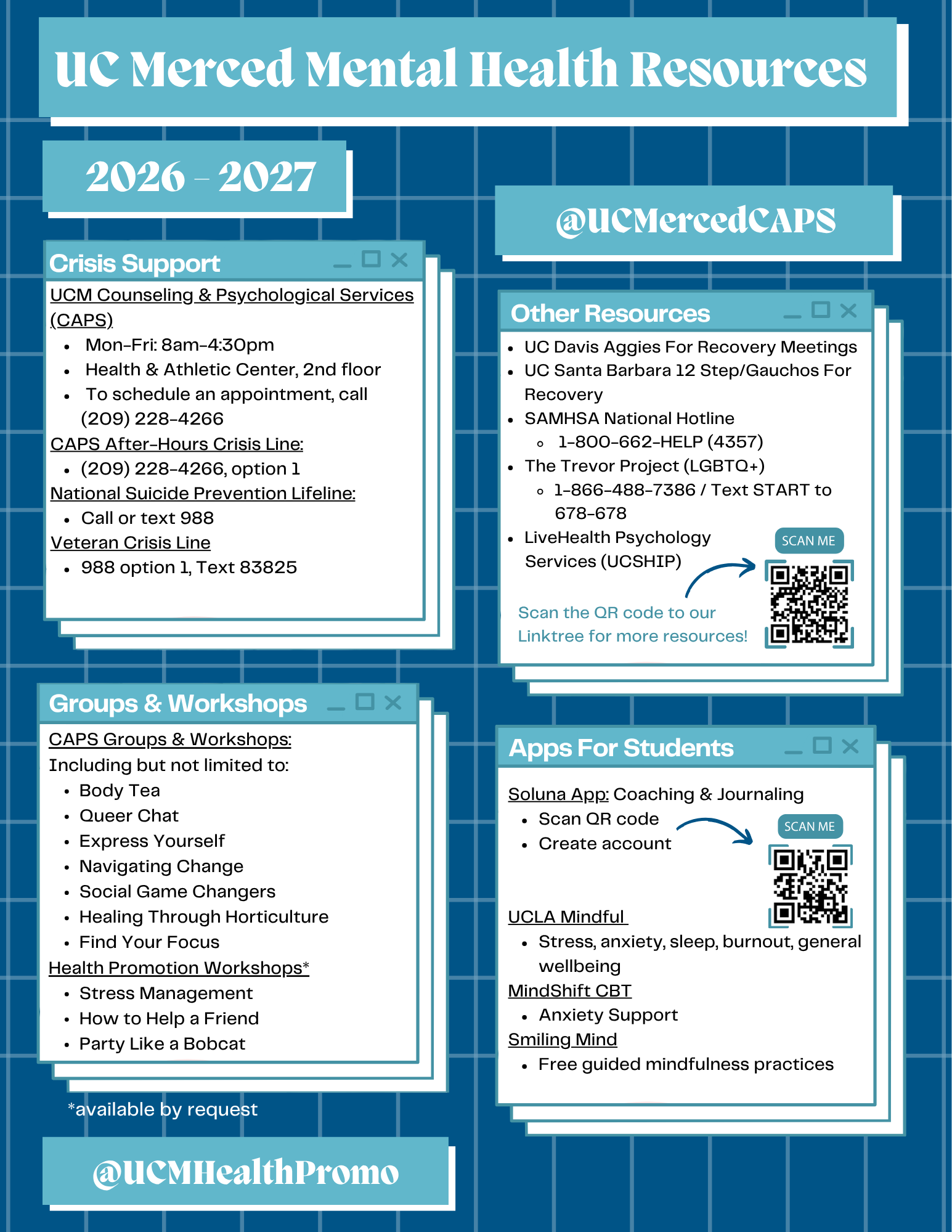
- Familiarize yourself with the various campus resources. Review resources on the Mental Health Resources poster and the Student Wellness Map.
- Know where to refer students. Familiarize yourself with the Red Folder for information on supporting students in psychological crisis and the Student of Concern reporting process.
More ideas:
- Share information about health and wellness resources in your Canvas course, in class, or during breaks, or invite guest speakers present on their services.
- Remind your students about the importance of sleep and discourage all-nighters; let them know sleep kits are available in the Health Promotion office.
- Use mindfulness or relaxation recordings for a break.
- Students struggle to concentrate if they’re hungry, and half of UC Merced students experience some level of food insecurity. Link students to campus resources for food (Basic Needs).